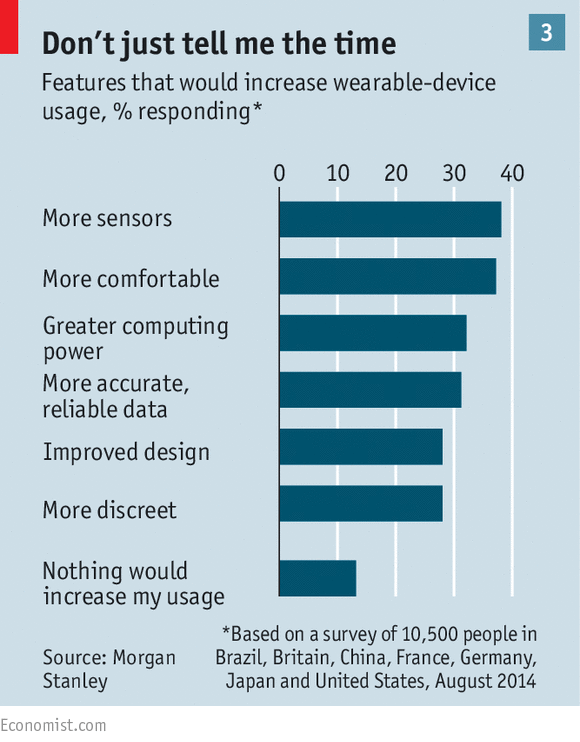
 Some analysts think wearables’ killer feature may eventually be that they will provide their users with a “persistent” digital identity, melding the functions of a driving licence, credit card, house key, car key and computer in one small gadget worn on the wrist or neck. To see what that future might look like, travel to the Disney World theme park in Orlando. Disney invested around $1 billion to build a system in which people use a wristband (called a MagicBand) to get on rides, pay for food and enter their hotel rooms. The technology is convenient for guests, who have to carry around fewer cards, but probably costs them more in the end, because it is so easy to buy something without thinking of the bill. The bands let Disney collect data in real time about the traffic their rides and restaurants are getting, so as to deploy staff to the right places. Other firms are taking tentative steps in a similar direction. Carmakers such as Hyundai are creating apps to let people unlock and start their cars remotely with their watches and phones.
Friday, March 13, 2015
Wearable technology: The wear, why and how
http://www.economist.com/news/business/21646225-smartwatches-and-other-wearable-devices-become-mainstream-products-will-take-more
Some analysts think wearables’ killer feature may eventually be that they will provide their users with a “persistent” digital identity, melding the functions of a driving licence, credit card, house key, car key and computer in one small gadget worn on the wrist or neck. To see what that future might look like, travel to the Disney World theme park in Orlando. Disney invested around $1 billion to build a system in which people use a wristband (called a MagicBand) to get on rides, pay for food and enter their hotel rooms. The technology is convenient for guests, who have to carry around fewer cards, but probably costs them more in the end, because it is so easy to buy something without thinking of the bill. The bands let Disney collect data in real time about the traffic their rides and restaurants are getting, so as to deploy staff to the right places. Other firms are taking tentative steps in a similar direction. Carmakers such as Hyundai are creating apps to let people unlock and start their cars remotely with their watches and phones.
Some analysts think wearables’ killer feature may eventually be that they will provide their users with a “persistent” digital identity, melding the functions of a driving licence, credit card, house key, car key and computer in one small gadget worn on the wrist or neck. To see what that future might look like, travel to the Disney World theme park in Orlando. Disney invested around $1 billion to build a system in which people use a wristband (called a MagicBand) to get on rides, pay for food and enter their hotel rooms. The technology is convenient for guests, who have to carry around fewer cards, but probably costs them more in the end, because it is so easy to buy something without thinking of the bill. The bands let Disney collect data in real time about the traffic their rides and restaurants are getting, so as to deploy staff to the right places. Other firms are taking tentative steps in a similar direction. Carmakers such as Hyundai are creating apps to let people unlock and start their cars remotely with their watches and phones.

Sex, Politics, & Putin
http://www.worldaffairsjournal.org/blog/alexander-j-motyl/sex-politics-and-putin

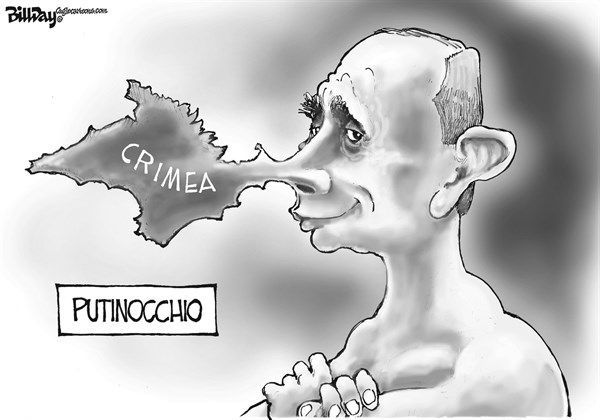
Putin’s actual accomplishments are few. He dismantled democracy and muzzled the media. He constructed a fascistoid regime and perverted the very notion of truth. He marginalized the democratic opposition and, at least until recently, crushed the North Caucasus independence movements. He annexed the Crimea and doesn’t know what to do with it. He started a war in eastern Ukraine and, once again, doesn’t know what to do next. The bottom line is that Russia remains a Belgium with a bomb and a profoundly corrupt petro-state incapable of technological innovation and sustained economic growth, while having become, under Putin, a rogue state.
Putin’s actual accomplishments are few. He dismantled democracy and muzzled the media. He constructed a fascistoid regime and perverted the very notion of truth. He marginalized the democratic opposition and, at least until recently, crushed the North Caucasus independence movements. He annexed the Crimea and doesn’t know what to do with it. He started a war in eastern Ukraine and, once again, doesn’t know what to do next. The bottom line is that Russia remains a Belgium with a bomb and a profoundly corrupt petro-state incapable of technological innovation and sustained economic growth, while having become, under Putin, a rogue state.
Thursday, March 12, 2015
Answering the Critics of a Tough Russia Policy
http://cepa.org/content/answering-critics-tough-russia-policy

....it is worth stressing that it is not NATO and EU expansion that have undermined the existing European security order. All the international agreements mentioned explicitly (and rightly) underline the right of individual countries to make choices about their future. If Belarus wants to join the Eurasian Economic Union, it can. The West is not going to invade that country’s western districts, or support insurrections there, on the grounds that the ancient Polish lands around Brest and Grodno have a different historical destiny and became part of Belarus only because of an accident of history. So why cannot Ukraine, for its part, make a decision to look to Europe?
....it is worth stressing that it is not NATO and EU expansion that have undermined the existing European security order. All the international agreements mentioned explicitly (and rightly) underline the right of individual countries to make choices about their future. If Belarus wants to join the Eurasian Economic Union, it can. The West is not going to invade that country’s western districts, or support insurrections there, on the grounds that the ancient Polish lands around Brest and Grodno have a different historical destiny and became part of Belarus only because of an accident of history. So why cannot Ukraine, for its part, make a decision to look to Europe?
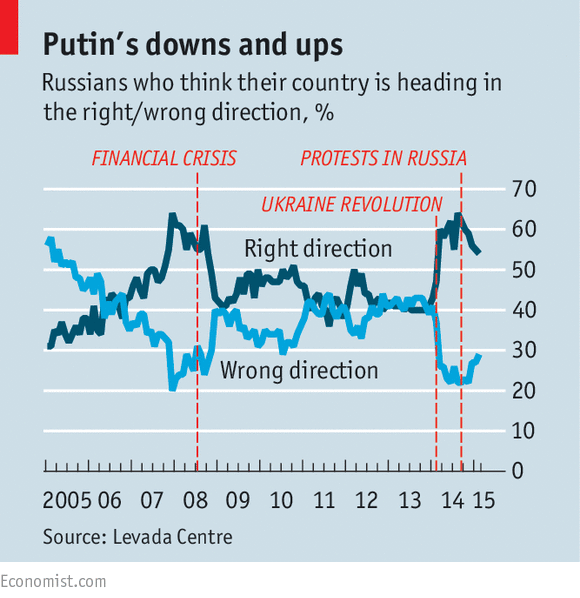
A Devil’s Dozen of Developments in Putin’s Russia
http://www.interpretermag.com/a-devils-dozen-of-developments-in-putins-russia/
Even though Vladimir Putin is extremely successful in managing the news about the big issues in Russian life, such as what he calls “the investigation” rather than the cover-up of the murder of Boris Nemtsov, he cannot control the flow of news items which directly or indirectly show the way in which his country is moving.
 |
| Source: +The Economist |
Путин, марьиванна и "украинцы в телевизоре"
http://www.svoboda.org/content/article/26840571.html
От КПСС до Путина: каков был путь к новой цензуре и новой медиареальности в России
От КПСС до Путина: каков был путь к новой цензуре и новой медиареальности в России

How the Kremlin & the Media Ended Up in Bed Together
http://www.themoscowtimes.com/opinion/article/how-the-kremlin-and-the-media-ended-up-in-bed-together/517323.html

"Editor's note: This is the longest text ever published by The Moscow Times. We've decided to publish it because it describes in detail a key Russian narrative, of how the Kremlin rules the country with the help of the controlled media. It is a bitter story of how the Russian media, with very few exceptions, have abandoned, sometimes through coercion, but mostly voluntarily and even eagerly, their mission of informing the public and have turned into creators of the Matrix-like artificial reality where imaginary heroes and villains battle tooth and nail in Russia's Armageddon"
"Editor's note: This is the longest text ever published by The Moscow Times. We've decided to publish it because it describes in detail a key Russian narrative, of how the Kremlin rules the country with the help of the controlled media. It is a bitter story of how the Russian media, with very few exceptions, have abandoned, sometimes through coercion, but mostly voluntarily and even eagerly, their mission of informing the public and have turned into creators of the Matrix-like artificial reality where imaginary heroes and villains battle tooth and nail in Russia's Armageddon"
Wednesday, March 11, 2015
Russian military shelled Ukraine from mid-July, report says
http://www.theguardian.com/world/2015/mar/11/russia-struggling-ukraine-military-operations-report
“The first operational successes of Ukrainian forces in late June and early July 2014 first prompted Russian artillery fire from within Russian territory, targeted against advancing Ukrainian troops on their own soil, from mid-July onwards,” the report’s author, Igor Sutyagin, writes. “Direct intervention by Russian troops in combat roles then followed in the middle of August, when the prospect of rebel defeat had become realistic. The presence of large numbers of Russian troops on Ukrainian sovereign territory has, more or less, since become a permanent feature of the conflict.”
“The first operational successes of Ukrainian forces in late June and early July 2014 first prompted Russian artillery fire from within Russian territory, targeted against advancing Ukrainian troops on their own soil, from mid-July onwards,” the report’s author, Igor Sutyagin, writes. “Direct intervention by Russian troops in combat roles then followed in the middle of August, when the prospect of rebel defeat had become realistic. The presence of large numbers of Russian troops on Ukrainian sovereign territory has, more or less, since become a permanent feature of the conflict.”
Russia Hacking The News
http://www.forbes.com/sites/peterhimler/2015/03/10/russia-hacking-the-news/
...no state is more duplicitous (and effective) in this regard than Mr. Putin’s Russia. Does anyone actually believe that Chechen separatists killed Putin adversary Boris Nemtsov? (In the non-state actor category, ISIS is giving Russia a run for its money.) Both examples cited in the Borthwick piece had their origins in Russia. The first propagated the false notion that 26% of French youth supported ISIS. It was based on a dubious survey:
“Beyond the methodology, the survey was commissioned by Russian news agency Rossiya Segodnya. The trail of the media breadcrumbs seem to be as follows: Rossiya Segodnya commissioned a survey to test support or opposition to the admissions of Georgia and the Ukraine into the EU, the ISIS question was secondary.”
...no state is more duplicitous (and effective) in this regard than Mr. Putin’s Russia. Does anyone actually believe that Chechen separatists killed Putin adversary Boris Nemtsov? (In the non-state actor category, ISIS is giving Russia a run for its money.) Both examples cited in the Borthwick piece had their origins in Russia. The first propagated the false notion that 26% of French youth supported ISIS. It was based on a dubious survey:
“Beyond the methodology, the survey was commissioned by Russian news agency Rossiya Segodnya. The trail of the media breadcrumbs seem to be as follows: Rossiya Segodnya commissioned a survey to test support or opposition to the admissions of Georgia and the Ukraine into the EU, the ISIS question was secondary.”
Britain may broadcast Putin's financial secrets to Russian people
http://www.telegraph.co.uk/news/worldnews/europe/russia/11461163/Britain-may-broadcast-Putins-financial-secrets-to-Russian-people.html?fb_ref=Default
Putin's money men
Vladimir Yakunin
Gennady Timchenko and wife Elena
Yuri Kovalchuk
Igor Sechin
Putin's money men
The wealth of Putin's inner circle runs to tens of billions of pounds.
Vladimir Yakunin

Vladimir Yakunin
Head of Russian Railways, the country's biggest employer, since 2005. He has been part of Putin's St Petersburg circle since the 1990s, and is dogged by claims from opposition activists over his wealth. He accompanies Mr Putin on overseas visit, and was in charge of construction during the Sochi Winter Olympics. He has been hit with US sanctions. His network is unknown but his official salary is $15 million.
Gennady Timchenko

Gennady Timchenko and wife Elena
Founder of Gunvor, the Swiss-based oil trader, he sold his stake just before being hit by US sanctions. His net worth is reckoned to be $14.5 billion, according to Forbes. Putin is said by the US to have "investments in Gunvor and may have access to Gunvor funds". The company strongly denies that claim, and has not been subject to foreign sanctions.
Yuri Kovalchuk

Yuri Kovalchuk
Once dubbed one of Putin's "cashiers". He is the largest shareholder of Bank Rossiya, called by the US the "personal bank for senior officials" of Russia. He is a member of the Ozero Dacha, a community of lakeside homes of Putin and his allies. His wealth is estimated to be $1.4 billion. He is hit by US and EU sanctions.
Arkady and Boris Rotenburg
Arkady is Putin's old judo partner, and is subject to EU sanctions.. The brothers have interests in pipelines, road construction and banking, and are presidents of Dinamo Moscow hockey and football clubs respectively. They received billions of dollars of contracts for the Sochi games. Their personal wealth is said to be $2.5 billion.
Igor Sechin

Igor Sechin
President of Rosneft, the state oil company, and the former deputy prime minister. His salary was $50 million last year. He is one of the most powerful figures in the administration, and is said to "economic interests" with Putin.
Monday, March 9, 2015
Murder of a friend - Edward Lucas
Murder of a friend
My immediate reaction to the opposition leader’s death on Friday evening was misery and fury. Now, it is fear. Fear for what the assassination of my friend may herald—either a return to a terrifying past, or a descent into a still more alarming future.
Edward Lucas
Boris Nemtsov was my closest friend in Russian politics. I had known him since the late 1990s when he was trying vainly to stem the sleaze and authoritarianism that eventually brought Putin and his ex-KGB cronies to power.
Unlike some Russian liberals, Nemtsov saw through Putin from the beginning. He disliked the new leader’s background as an unrepentant KGB officer, and worried about his murky years spent in the city administration of gangster-ridden St Petersburg.
He decried the political bargain that the new regime offered as sinister and misleading: Russians craved stability but it should not come at the price of ending political pluralism.
As the regime tightened its grip on the electoral system, Nemtsov and other liberals were excluded from public life. He turned to protests and to investigating corruption and incompetence.
One set of possibilities surrounds the theory that his assassination was ordered by the Putin regime. It could be a simple attempt to silence him. Nemtsov was about to release a report on Russia’s war in Ukraine. I doubt that would justify his murder. His other investigative reports were damning—but they had little impact, because the official media ignored them. Russia’s role in attacking and destabilising Ukraine is well proven. The shortage is not of more evidence, but of will power in the West. Even Nemtsov could not provide that.
Nor do I think it likely that he was killed to forestall a protest march planned for last Sunday. The opposition in Russia is barely worthy of the name: Nemtsov himself told the FT shortly before his death that he was now a mere dissident. The regime has plenty of way of keeping its quarrelsome and marginal critics in check, chiefly by harassing them through the criminal justice system. Why add the extra complication of murder?
More likely is that the killing was symbolic. The official media, with suspicious unanimity, is taking the line that Nemtsov was murdered by other opposition elements, or possibly their foreign paymasters, in order to destabilise Russia.
It is hard to follow this perverse reasoning, or to find any facts to support it. But as with the Kirov murder in 1934, which gave Stalin reason to purge Soviet life of any dissent, Nemtsov’s killing could give the regime grounds for launching a serious crackdown.
Russia’s history is drenched in blood and tears. Countless people died in the Stalinist purges of the late 1930s. The pretext for these purges was a spectacular murder. The bon vivant Sergei Kirov, Communist Party boss in Leningrad, was a growing threat to the brutal, suspicious Josef Stalin.
Though a die-hard communist, he thought the country’s leadership had gone too far. Kirov objected to the persecution of the Soviet peasantry which had led to lethal famines in Ukraine and elsewhere. And he resisted Stalin’s manic, paranoid tightening of Communist Party discipline.
That cost him his life. In a mysterious shooting on December 1st 1934—amid astonishing negligence by his bodyguards, in a prestigious party headquarters building, the Smolny Institute—Kirov was shot dead.
Stalin responded with a vehement public condemnation. He carried the coffin at Kirov’s funeral and took personal charge of the investigation. But it mushroomed into a massive purge of the Party—and then the whole country. Hysterical suspicions, of treason, terrorism, sabotage, and espionage, swirled through every corner of Soviet life.
Yet even similar motives as with the Kirov murder seem a bit unlikely. True, the Kremlin likes phoney legalism to mask its repression at home and aggression abroad. But why go to the trouble of killing Nemtsov, when so many other pretexts abound?
Most likely is that Nemtsov’s killing was a political signal from one part of Russian politics to another: that it is now acceptable to kill a former deputy prime minister within a stone’s throw of the Kremlin. The fact that the murder happened on the newly proclaimed Special Forces Day may have something to do with it.
In the Kremlin’s propaganda the Russian opposition, along with Zionists, Fascists, paedophiles and CIA plots are stitched together into fiendish plots against holy Mother Russia. Some senior Russians know privately that it is nonsense. After all, they educate their children in this demonic West, and invest their money there. But others believe it.
Boris Nemtsov—brilliant, charming, handsome, honest and brave—was no Kirov. He was no blood-stained Communist apparatchik, but a physicist who turned to politics out of patriotism. Nemtsov was a pro-Western Jewish liberal who bravely decried Russia’s war in Ukraine as an outrage, was a particular hate figure among these people. Many would like to kill him anyway—especially if it would also signal to the Kremlin that if the regime does not get tough with traitors, others will.
The official reaction to Nemtsov’s murder has the most sinister overtones of the past. The Russian president Vladimir Putin has taken personal charge of the investigation of his opponent’s death.That is offensive as it is farcical. The many murders and beatings of Kremlin critics in recent years have gone unsolved, amid bluster, confusion and incompetence.
The authorities show no sign of treating this case any differently. The investigators detained Mr Nemtsov’s girlfriend, a Ukrainian model, and have ransacked his apartment, seizing his computers and papers.
But the truly chilling echo of the Kirov case comes in the media coverage. Russia has already descended into a propaganda hell in which the Russian opposition, along with Zionists, Fascists, paedophiles and CIA plots are stitched together into fiendish plots against holy Mother Russia.
That is all too reminiscent of the Stalinist media in the 1930s. Dissent is treason. Contact with foreigners is espionage. Enemies are everywhere.
As Karen Dawisha, a brave American academic who has laid bare the links between the Putin regime and gangsterdom, has written, “when the Kremlin publicly labels the opposition leaders as enemies, and spews out nothing but hatred toward those who have a right to demand freedom, then killings – irrespective of who pulled the trigger—are a logical result.”
Now—in a truly sinister twist reminiscent of the Kirov case—official media is blaming Nemtsov’s allies in the opposition for his murder. In the Kremlin’s perverse logic, they are the likely culprits, because they will benefit from the outrage around the killing.
In truth, that outrage is limited. A demonstration yesterday attracted tens of thousands of mourners—a respectable total, but not nearly enough to rock the regime. The shooting instils fear, rather than stoking indignation.
Many critics of the regime, in Russia and abroad, are asking who will be next.
My friend Yevgenia Albats, editor of one of the few remaining independent magazines in Moscow, says: “the hunting season is open.”
The logic may be bizarre, but there is no doubting the Putin regime’s determination to stay in power.
If, as the regime seems to be arguing, the Nemtsov killing was an attempt by the opposition and its foreign paymasters to destabilise Russia, then the response must be ruthless. Lies and terror will have Russia in their grip.
It may be hard to imagine anything more unpleasant than the crooked spooks of the Putin inner circle. But the climate they have created is fostering even more loathsome elements.
They include the fearsome legions of the despotic Ramzan Kadyrov, the eccentric strongman leader of Chechnya. Having lost a war of secession against Moscow, the warlike Chechens have now thrown in their lot with Putin—and have gained increasing and sinister influence in Russian politics as a result.
Of similar vein are the separatist insurgents in eastern Ukraine. Thuggish paramilitaries, often with ties to organised crime, they are like the hard men of the Troubles generation in Northern Ireland. Like the IRA and UDA they have a taste for violence, coupled with intransigent, extremist political views.
In the case of the new Russian hardliners, these are a toxic cocktail of Stalinist nostalgia, overt fascism, ultra-orthodox religiosity and a bitter hatred of the West. Some are also part of motorcycle gangs with exotic names such as the Night Wolves.
These people do not see Mr Putin as a sinister tyrant. They think he is too soft.
They would have no compunction in murdering someone like Nemtsov—and might see it as a way of signalling to the Kremlin that if the regime does not get tough with traitors, others will.
I hope we in the West are ready for an era in Russia which may make the last 15 years seem like little more than mild inconvenience.
Edward Lucas is the author of The New Cold War: Putin’s Threat to Russia and the West, and Deception: Spies, Lies and How Russia Dupes the West
Subscribe to:
Posts (Atom)